

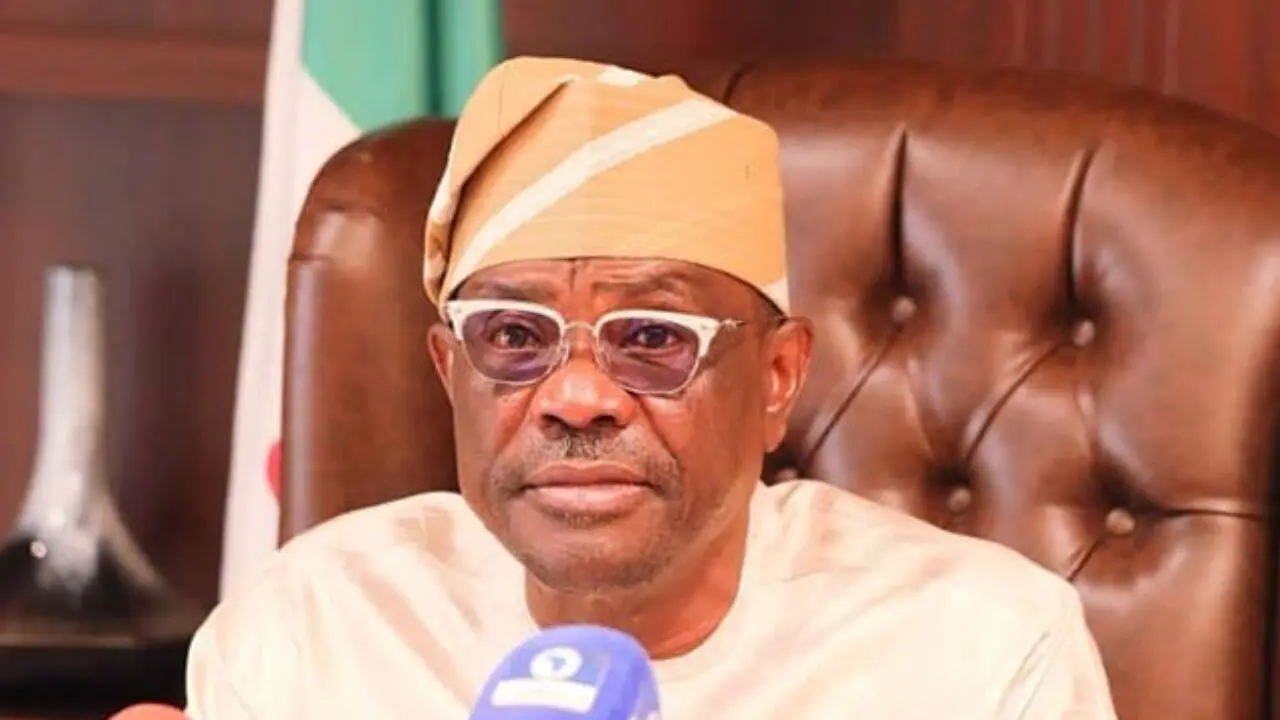
Politics, at its highest level, is not merely about power, strategy, or even results; it is about temperament, loyalty, and moral restraint. History has repeatedly shown that brilliance without character is a temporary spark, while power without discipline ultimately consumes its owner. The unfolding drama around Barrister Nyesom Wike appears to be another vivid illustration of this eternal lesson.
Once celebrated as a fearless political gladiator, Wike today cuts a markedly different figure—measured in speech, guarded in tone, and noticeably restrained in body language. His most recent media chat, stripped of the swagger and verbal fireworks Nigerians had grown accustomed to, betrayed a man acutely aware that the ground beneath his feet is shifting.
From the moment the PDP threw open its presidential ticket in 2022 without zoning to the South, Wike’s political journey took a sharp moral detour. His failure to clinch the vice-presidential slot under Atiku Abubakar appears to have crystallised a resolve not to rebuild the party, but to rupture it. What followed was not opposition politics, but internal sabotage—a long, calculated season of rebellion that weakened the PDP and confused its base.
Leadership scholars and statesmen have long warned against this path.
“Character is like a tree and reputation like its shadow. The shadow is what we think of it; the tree is the real thing.” — Abraham Lincoln

Wike’s reputation as a “strongman” may have cast a long shadow, but the tree—defined by loyalty, restraint, and collective responsibility—has increasingly been called into question.
The defection of Governor Siminalayi Fubaratoo from the APC has fundamentally altered the power equation in Rivers State. Unlike Wike, Fubara is not ruling by proxy or influence; he is the sitting governor, presiding over one of Nigeria’s wealthiest and most strategically important states. With APC governors openly rallying around him, Wike’s relevance to the ruling party has diminished sharply. He is no longer an asset of convenience; he has become a complication.
This development confirms what many APC insiders privately felt all along: Wike was tolerated, not trusted. His excesses were overlooked only because they served a short-term political advantage. Now that a more institutionally rooted alternative exists in Rivers State, that tolerance is evaporating.
The public altercation involving Officer Yarima was a turning point—not because of the incident itself, but because of the reaction it triggered nationwide. For the first time, public sympathy tilted decisively against Wike. The avalanche of ridicule, satire, and open disdain exposed a truth politicians often ignore: fear does not equal respect.
Nelson Mandela captured this balance succinctly:
“A good head and a good heart are always a formidable combination.”
Wike’s political career has never lacked sharpness of intellect or tactical boldness. What increasingly appears absent is the “good heart”—the capacity for humility, forgiveness, and institutional loyalty that sustains long-term leadership.

His recent tours across Rivers State, complete with carefully staged photo-ops alongside PDP and APC chairmen, look less like confidence and more like anxiety management. Influence is not proven by pictures; it is proven by obedience, loyalty, and organic followership. Where money must lubricate relevance, authority has already begun to leak.
Perhaps Atiku Abubakar’s decision not to pick Wike as a running mate now reads less like political miscalculation and more like instinctive wisdom. As Dwight D. Eisenhower once noted:
“Leadership is the art of getting someone else to do something you want done because he wants to do it.”
Coercion, intimidation, and transactional loyalty can win battles, but they rarely win hearts—and never win history.
Wike himself has admitted he struggles to keep friends. That confession may be the most honest political statement he has ever made. Politics, like life, is a marathon of relationships. A man loyal only to himself eventually finds himself standing alone.
So, is this the beginning of Wike’s end?
Not necessarily the end of relevance—but possibly the end of unchecked dominance. Political careers do not always collapse dramatically; some simply fade, overtaken by new actors, new alliances, and changing moral expectations. What is clear is that attitude—not brilliance, not resources, not past victories—is now the central issue.
As Mahatma Gandhi warned generations ago:
“The best way to find yourself is to lose yourself in the service of others.”
Power hoarded breeds isolation. Power shared builds legacy.
Rivers State politics has entered a new chapter. Whether Wike adapts with humility or doubles down on confrontation will determine not just how history judges him—but how soon it turns the page.
Let’s learn from this: he has done a bad job successfully, but he has also shown clearly the kind of person he is.
Rotimi Johnson Ojasope BSc, PGDPA, ANIPR, FPD-CR,
Public Affairs Analyst
