

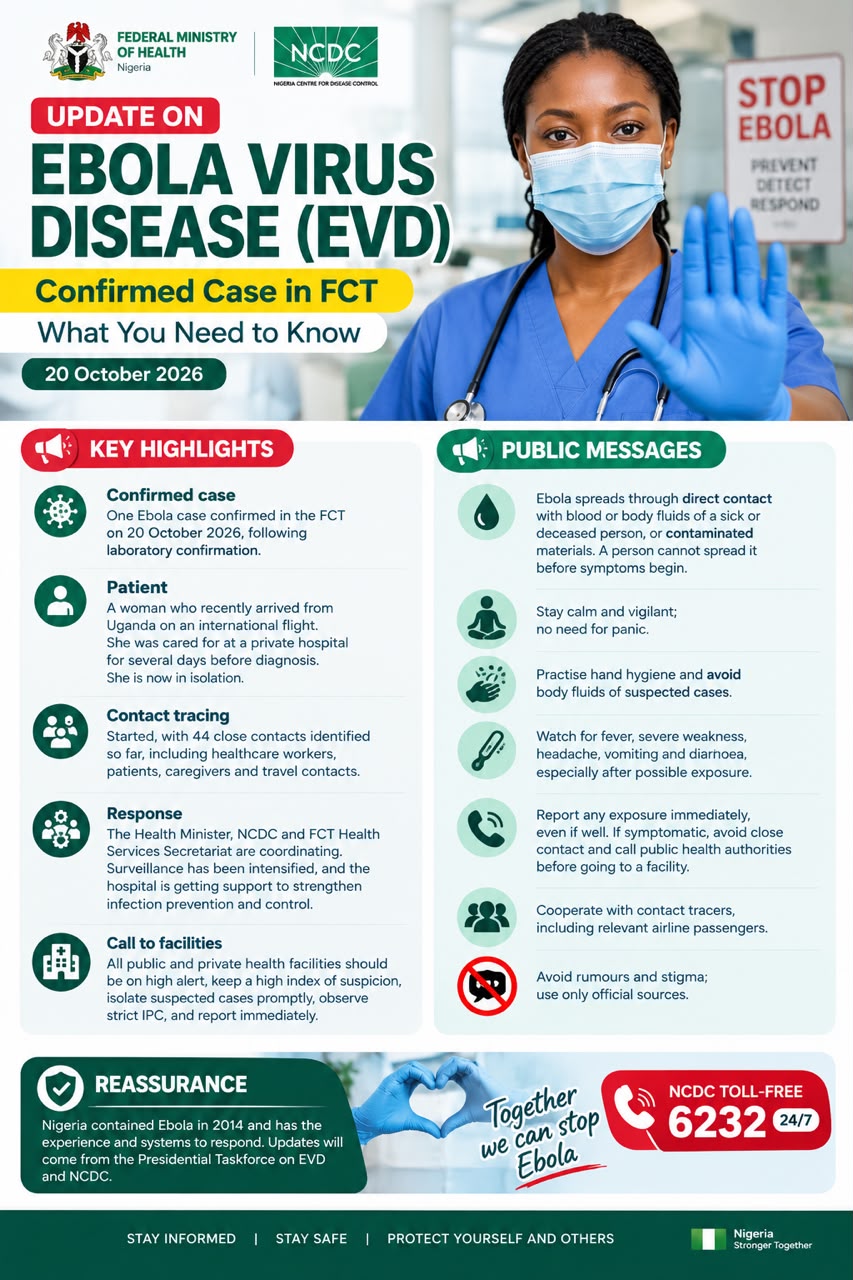
The Federal Government has confirmed Nigeria’s first case of Ebola Virus Disease in the Federal Capital Territory (FCT), Abuja, with public health authorities identifying 44 contacts as part of efforts to prevent further transmission.

The Coordinating Minister of Health and Social Welfare, Professor Muhammad Ali Pate, announced the laboratory-confirmed case on Tuesday, saying the infected patient, a woman with a recent travel history involving Uganda, was receiving medical care in isolation.
According to the minister, the woman was admitted to a private hospital in Abuja after developing symptoms, with further tests subsequently confirming the infection.
Health authorities have commenced contact tracing to identify, locate and monitor people who may have been exposed to the patient. The identified contacts include healthcare workers, patients, caregivers and travel-related contacts.
The Federal Ministry of Health and Social Welfare, the Nigeria Centre for Disease Control and Prevention (NCDC), and the FCT Health Services Secretariat are coordinating the response, while investigations continue to determine whether additional people may have been exposed.
The private hospital where the woman received treatment is also receiving support to strengthen infection prevention and control measures and reduce the risk of further transmission.
The government has urged public and private healthcare facilities nationwide to remain on high alert, promptly identify and isolate suspected cases, maintain strict infection prevention and control procedures, and immediately report suspected infections to the appropriate public health authorities.
Regional outbreak raises concern
Nigeria’s latest case comes amid an ongoing regional Ebola outbreak involving the Bundibugyo virus, with the Democratic Republic of the Congo (DRC) at the centre of the public health emergency.
The outbreak has raised concerns about cross-border transmission, prompting health authorities across affected and potentially exposed countries to strengthen surveillance, particularly at international points of entry.
Kenya has also reported cases linked to the regional outbreak, while Uganda, through which the Nigerian patient reportedly travelled, had previously reported Ebola infections before declaring its outbreak over.
However, travel through a country does not necessarily establish where an infection was acquired. Authorities are expected to rely on epidemiological investigations and the patient’s travel history to determine the likely source of the infection.
The Nigerian case is therefore being treated as an imported infection as investigations and contact tracing continue.
Nigeria recalls successful 2014 Ebola response
The development brings back memories of Nigeria’s 2014 Ebola outbreak, which began after Patrick Sawyer, a Liberian-American traveller infected with the virus, arrived in Lagos on July 20 that year.

The outbreak resulted in 20 confirmed cases and eight deaths, including the index case. Among those who died was Dr Ameyo Adadevoh, the physician widely recognised for helping to prevent further transmission by restricting Sawyer’s movement despite pressure to release him.
Nigeria eventually contained the outbreak through coordinated surveillance, prompt isolation of infected persons, contact tracing and other public health interventions.
The World Health Organisation declared Nigeria free of Ebola transmission on October 20, 2014, after the country completed the required period without new cases.
The experience has since been regarded as an important example of how rapid detection, effective coordination and systematic contact tracing can help contain an Ebola outbreak.
FG urges calm, vigilance and cooperation
Following the latest confirmation, Pate urged Nigerians to remain calm and vigilant, stressing the importance of public cooperation in preventing further spread of the disease.
He advised members of the public to practise regular handwashing and avoid direct contact with the blood and other body fluids of anyone suspected of having Ebola.
Ebola can spread through direct contact with the blood or other body fluids of an infected person who is showing symptoms, as well as through contaminated materials. Possible symptoms include fever, severe weakness, headache, vomiting and diarrhoea.
Members of the public who develop symptoms after a possible exposure are advised to seek guidance from public health authorities before visiting a healthcare facility, helping to minimise the risk of exposing others.
The government has also urged anyone contacted by public health teams during the tracing exercise, including people who may have travelled with the patient, to provide the requested information and comply with official instructions.
Authorities are intensifying surveillance at points of entry and strengthening preparedness across the health sector as investigations continue.
The government has further appealed to Nigerians to rely on verified updates from the Federal Ministry of Health and Social Welfare and the NCDC, warning against the circulation of unverified information and the stigmatisation of people who may have been exposed.
Public health officials maintain that early detection, prompt isolation, effective contact tracing and cooperation from members of the public remain central to containing the infection and preventing a wider outbreak.
