

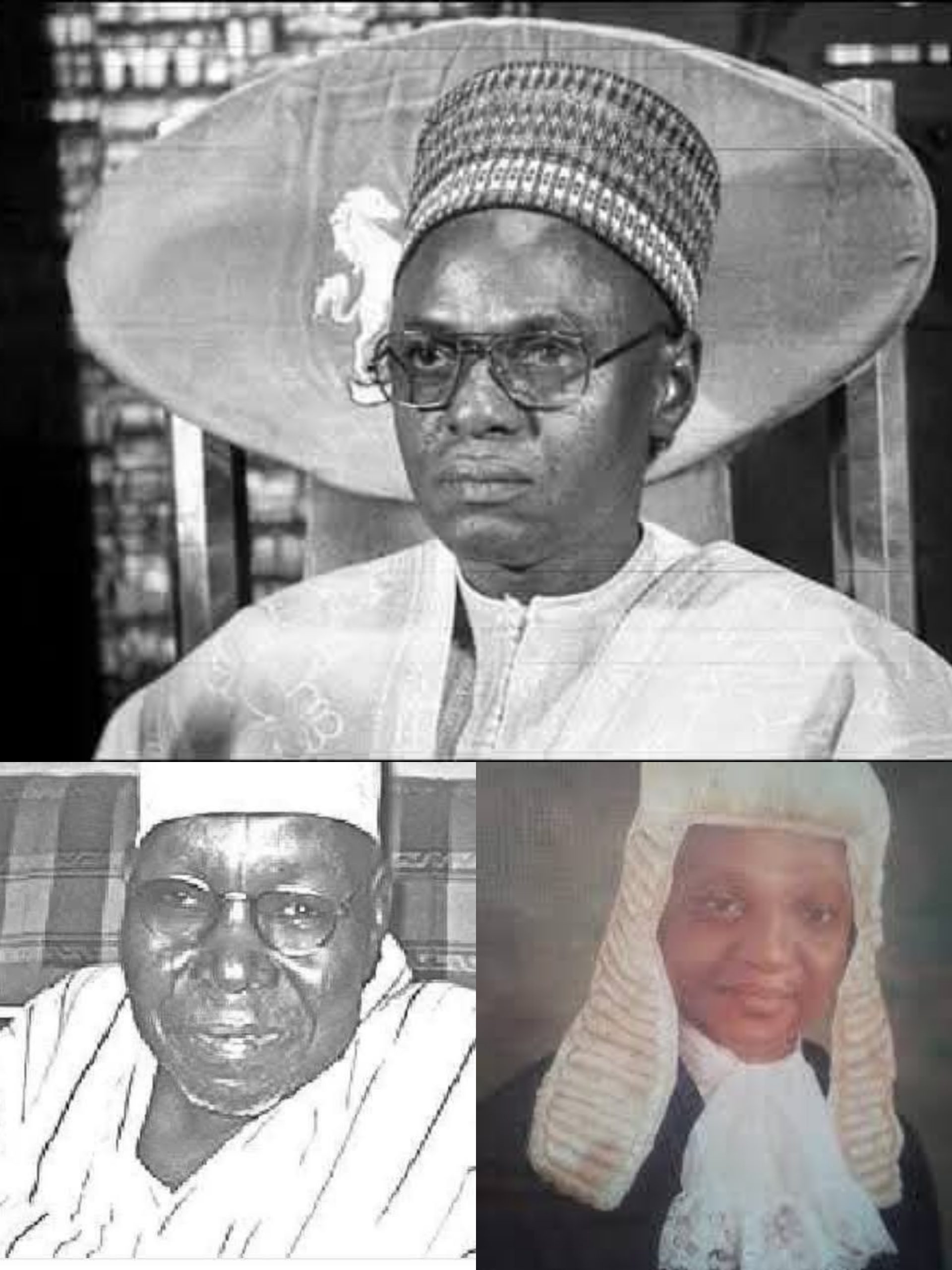
You will think that the government witch-hunt of opposition voices started today until you hear the very funny but interesting case of Shugaba Darman.
Sometime in January 1980, a man called Alhaji Shugaba Abdurrahaman Darman ran into serious trouble with the administration of Alhaji Shehu Shagari.
What exactly did he do?
Alhaji Shugaba Abdurrahaman Darman was a highly charismatic politician and the Majority Leader of the Great Nigeria People’s Party (GNPP) in the Borno State House of Assembly.
At the time, he was known as one of the strongest opposition voices against the administration of President Shehu Shagari of the National Party of Nigeria (NPN).
Shugaba Darman was so vocal that his growing political influence across the North-East was seen as a major threat to the federal ruling party.
So, what did the government of Shehu Shagari do?
Shugaba Darman was framed.
His Nigerian passport was seized, and he was suddenly deported across the border to Chad.
According to the Federal Government, Shugaba was not a Nigerian at all. They declared him a “prohibited immigrant” and a threat to national security.
Imagine that.
A man who had risen to become the Majority Leader of a political party in a Nigerian State House of Assembly was suddenly told he was not a Nigerian.
While Shugaba Darman remained in exile as a deported refugee, the legendary Chief G.O.K. Ajayi, SAN, went to court on his behalf to challenge the action of the Federal Government.
The Federal Government appeared in court and insisted that Shugaba was not a Nigerian citizen because his father was born in Chad.
To strengthen that narrative, the government even brought an elderly Chadian woman into court, who broke down in tears and claimed that Shugaba was her long-lost biological son.
It sounded like a movie.
But Shugaba vehemently denied ever knowing the woman. Instead, he proved that his biological mother was a well-known, nearly blind Nigerian woman living in Maiduguri.
Chief G.O.K. Ajayi then advanced a powerful constitutional argument.
He argued that under Section 23 of the 1979 Constitution of Nigeria, Shugaba was a citizen of Nigeria by birth because his mother was a Nigerian citizen, irrespective of his father’s Chadian origin.
He further convinced the court that, as a citizen by birth, Section 38 of the 1979 Constitution (now Section 41 of the 1999 Constitution) expressly guaranteed Shugaba’s freedom of movement, meaning he could never be expelled or deported from Nigeria.
The legal battle eventually travelled from the High Court to the Supreme Court.
When the Supreme Court finally heard the matter, it sided with G.O.K. Ajayi.
Justice D. O. Coker, who delivered the lead judgment, made it abundantly clear that under the 1979 Constitution, a Nigerian citizen by birth cannot be deported under any circumstance.
The court further held that executive action must always bow to constitutional limitations and that the Minister of Internal Affairs does not possess unfettered discretion over national security where the fundamental liberties guaranteed by the Constitution are involved.
In the end, the Supreme Court declared the action of the Federal Government null and void, holding that it was malicious and politically motivated.
Shugaba Darman was subsequently awarded ₦350,000 as damages.
That landmark decision established the principle that still stands today: no matter the offence allegedly committed by a Nigerian citizen by birth, such a person cannot be deported from Nigeria under any circumstances.
To this day, lawyers still cite the case as Abdulrahman Darman v. The Federal Minister of Internal Affairs & Others (1981) 2 NCLR 459.
History has a way of reminding us that the struggle between those in power and strong opposition voices is not new.
It has simply taken different forms across different generations.
Credit Ekene Aninze Esq.
