
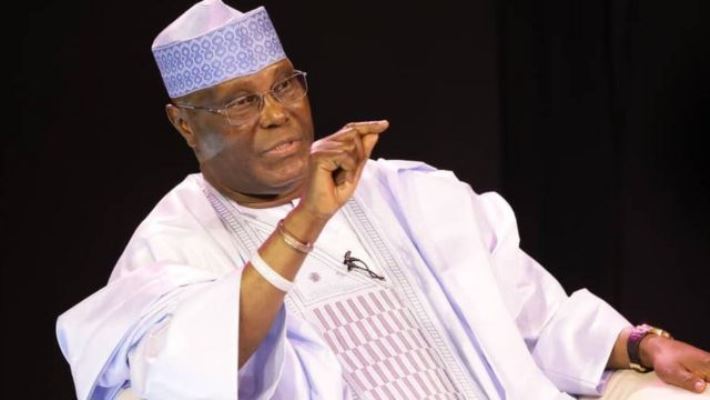
Former Vice President and presidential candidate of the African Democratic Congress (ADC), Alhaji Atiku Abubakar, has called on President Bola Ahmed Tinubu to immediately reverse the Federal Government’s approval of a uniform ₦50,000 registration fee for the West African Examinations Council (WAEC) and National Examinations Council (NECO) Senior School Certificate Examinations.
Atiku warned that the new fee regime, scheduled to take full effect from the 2027 internal examination cycle, could worsen Nigeria’s already alarming out-of-school children crisis by making secondary school certification unaffordable for millions of low-income families.
The approved ₦50,000 fee represents an 82 per cent increase from the previous baseline registration fee of ₦27,500 for both WAEC and NECO internal senior school certificate examinations.
The approval was formalised through a Federal Ministry of Education memorandum signed by the Director of Senior Secondary Education, Mr. Adeniji Ibrahim, following a request by the regional examination bodies for an upward review of the fees.
Reacting to the development in a statement issued on Sunday, July 12, 2026, by his Senior Special Assistant on Public Communication, Phrank Shaibu, Atiku described the policy as “cruel, economically insensitive and unconscionable.”
He accused the Tinubu administration of erecting financial barriers between ordinary Nigerians and access to basic human capital development, arguing that education should remain accessible to every Nigerian child irrespective of economic background.
According to the former Vice President, the timing of the increase is particularly troubling, as millions of Nigerian households are already struggling with record inflation, rising food prices, crippling electricity tariffs, stagnant wages and high unemployment.
“A government that genuinely believes in the future of its people does not erect financial barriers between children and education; it removes them,” Atiku stated.
“Education is not a privilege reserved exclusively for the wealthy; it is the fundamental birthright of every Nigerian child and the sole instrument of social mobility for millions from humble backgrounds.”
Under the new unified pricing framework, parents and guardians who previously paid ₦27,500 to register their children for either WAEC or NECO internal examinations will be required to pay ₦50,000 from 2027, an increase of ₦22,500, representing approximately 82 per cent.
Atiku also expressed concern that the examination fee increase comes alongside recent increases in administrative charges across Federal Unity Colleges nationwide, a development critics have described as a “double punishment” for low-income families whose children attend public schools.
Highlighting the scale of Nigeria’s education crisis, the former Vice President cited estimates placing the country’s out-of-school children population between 10.5 million and 15 million.
He argued that rather than introducing aggressive and subsidised interventions capable of returning millions of children to classrooms, the government was pursuing policies that could further increase the number of children excluded from formal education.
Atiku also questioned what he described as a contradiction in the Federal Government’s broader tertiary education policy.
While the administration has repeatedly promoted the Nigerian Education Loan Fund (NELFUND) as a means of expanding access to higher education, Atiku argued that increasing the cost of prerequisite senior secondary school examinations could prevent millions of indigent students from ever qualifying for university admission and, consequently, from accessing the education loan scheme.
The former Vice President maintained that making WAEC and NECO examinations unaffordable would effectively shut the doors of tertiary education against children from poor families before they even have the opportunity to apply for admission or student loans.
He consequently urged President Tinubu to shelve the proposed uniform ₦50,000 examination fee, halt the ongoing increases in fees at Federal Unity Colleges and return to what he described as sustainable education subsidisation measures.
Insisting that “no nation has ever taxed its way into educational excellence,” Atiku also called on the Federal Ministry of Education to urgently convene an all-inclusive stakeholders’ dialogue on education financing.
He stressed that meaningful economic reforms must protect basic human development sectors, urging the government to expand educational infrastructure, recruit more teachers and ensure that poverty does not determine a child’s access to education.
