

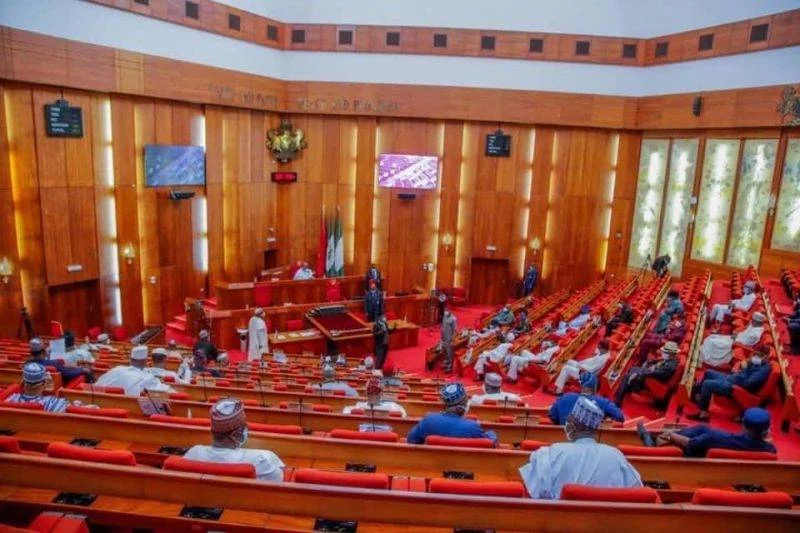
Nigeria has moved a step closer to adopting a decentralised policing system following the passage of the Constitution of the Federal Republic of Nigeria (Alteration) (State Police) Bill, 2026, by both chambers of the National Assembly.
The landmark constitutional amendment, regarded as one of the most significant security reforms in the country’s history, seeks to replace the long-standing centralized structure of the Nigeria Police Force (NPF) with a dual policing framework comprising a Federal Police Service and State Police Services across the 36 states.
The latest breakthrough came on Wednesday, June 24, 2026, when the Senate approved the executive bill after fast-tracking it through all legislative stages in a single day. The development followed the transmission of a revised constitutional alteration proposal to the Senate by President Bola Ahmed Tinubu on June 23.
Presided over by Senate President Godswill Akpabio and led by Senate Leader Senator Michael Opeyemi Bamidele, the upper chamber held a nearly three-hour closed-door executive session before proceeding to an open vote. More than two-thirds of the 109 senators voted in support of the bill through a manual show of hands, surpassing the constitutional requirement of 73 votes.
The Senate’s approval came weeks after the House of Representatives passed the measure on June 10, 2026. The lower chamber, under the leadership of Speaker Tajudeen Abbas and Deputy Speaker Benjamin Kalu, who also chairs the House Committee on Constitution Review, endorsed the bill—then known as the Sixth Alteration Bill—with 288 lawmakers voting in favour and only four opposing it.
The legislation amends Section 214 of the 1999 Constitution and establishes a two-tier policing structure consisting of a strengthened Federal Police Service and separate State Police Services.
Under the new framework, state governors will appoint State Commissioners of Police based on recommendations from the National Police Council, subject to confirmation by their respective State Houses of Assembly.
Governors will also be empowered to issue lawful written directives on matters relating to public safety and order. However, where a State Commissioner of Police considers such directives unlawful or inconsistent with national policing standards, the matter will be referred to the National Police Council, whose decision will be final and binding.
The bill further provides that no state police service can commence operations until the state passes enabling legislation and satisfies operational, structural and financial requirements to be prescribed by an Act of the National Assembly. Until those conditions are met, the Federal Police Service will continue to exercise full policing authority within the affected state.
Explaining the rationale behind the bill, Senate Leader Michael Opeyemi Bamidele said:
“The principal objective of this bill is to establish a constitutional framework for the creation and operation of State Police Services while retaining a strong Federal Police Service and maintaining national standards, accountability, and oversight.”
To address concerns that state governors could misuse local police formations for political purposes, lawmakers incorporated several safeguards into the proposed constitutional framework.
The bill expressly prohibits governors from directing state police authorities to target individuals, political parties, civil society groups or regional organizations. It also bans the use of state police powers for partisan, ethnic, religious or sectional interests.
In addition, independent State Police Service Commissions will be responsible for recruitment, promotions and disciplinary matters, a measure intended to protect officers from political interference and victimization.
Despite the proposed decentralization, the Federal Government will retain significant intervention powers. Under the amended Section 214, the Federal Police Service may intervene directly in any state experiencing an actual or imminent breakdown of public order, where a state police service becomes incapable of performing its duties effectively, or where national security is threatened.
In such situations, and with presidential authorization as well as Senate oversight, the Federal Police Service may temporarily assume full operational control of security activities within the affected state.
Although the bill has now secured approval from both chambers of the National Assembly, it must still scale another constitutional hurdle before becoming law.
The proposed amendment will be transmitted to the 36 State Houses of Assembly for consideration. For the alteration to become part of the Constitution, it must be ratified by at least 24 state assemblies before being returned to Abuja for presidential assent.
Analysts believe the measure stands a strong chance of obtaining the required support, given the longstanding demand by the Nigeria Governors’ Forum for greater state control over security operations.
