

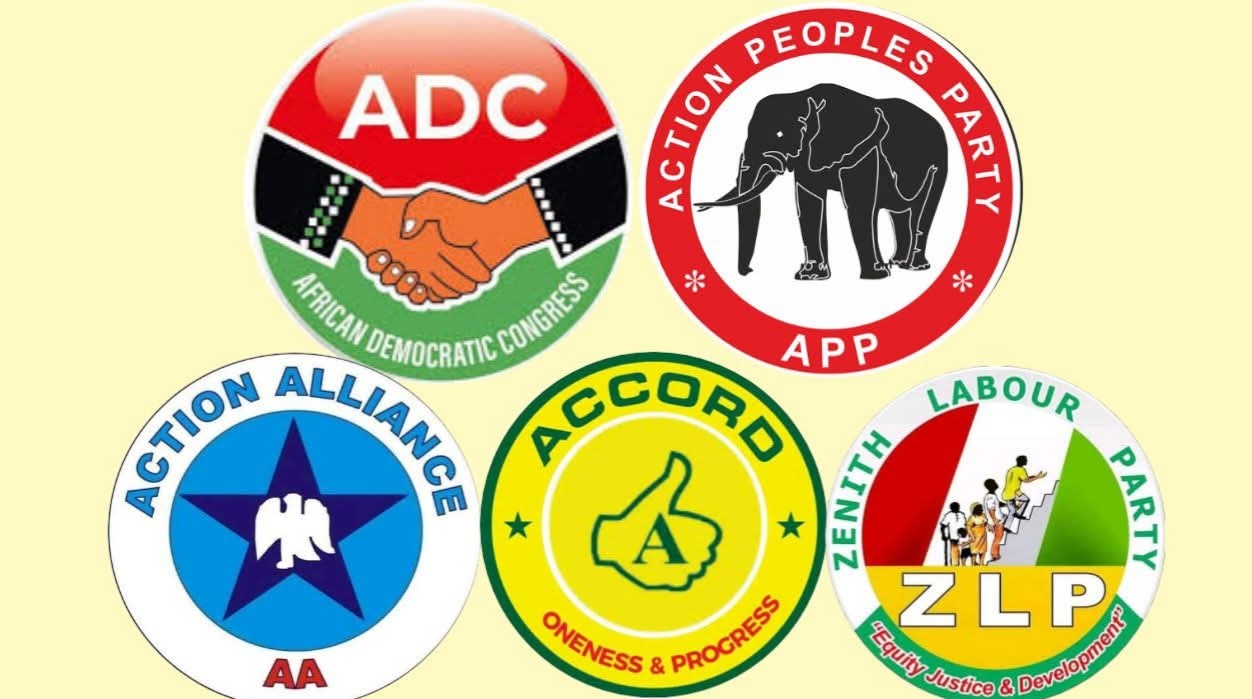
A major judicial decision has sent shockwaves through Nigeria’s political landscape ahead of the 2027 general elections. The Federal High Court sitting in Abuja has ordered the Independent National Electoral Commission (INEC) to immediately deregister the African Democratic Congress (ADC) along with four other opposition political parties.
The other affected political platforms ordered for axing by the court are the Action Peoples Party (APP), Action Alliance (AA), Accord Party (AP), and the Zenith Labour Party (ZLP).
The order follows a definitive judgment delivered by presiding judge, Justice Peter Lifu, in a high-profile legal battle that has been brewing in the federal capital for months.
The decisive court order was the outcome of a public interest lawsuit marked FHC/ABJ/CS/2637/2026, which was instituted by the Incorporated Trustees of the National Forum of Former Legislators (NFFL).
In their substantive suit, the former lawmakers had approached the court to legally determine whether INEC has a mandatory constitutional obligation to purge the national register of political parties that fail to meet the strict electoral performance thresholds established under Nigerian law. Specifically, the plaintiffs pointed to Section 225A of the 1999 Constitution of the Federal Republic of Nigeria (as amended), which is reinforced by the statutory provisions of the Electoral Act 2022 and INEC’s internal regulatory guidelines.
Under Section 225A, the electoral umpire is empowered and required to dismantle any political party that fails to win at least 25 per cent of the votes cast in at least one state of the federation during a presidential election, or fails to secure at least one seat in either the National Assembly (Senate and House of Representatives) or a State House of Assembly.
The legal battle leading up to Justice Lifu’s final judgment was intensely contested. During the proceedings, the Federal Government, through the Attorney General of the Federation and Minister of Justice, Chief Lateef Fagbemi (SAN), threw its full weight behind the suit. The chief law officer argued that underperforming political parties heavily contribute to ballot paper congestion, complicate logistics, and ultimately lead to the waste of public resources during national elections.
In a desperate bid to stave off the judgment, the embattled opposition parties had previously filed multiple applications urging the Federal High Court to stay or completely suspend its proceedings, pointing to parallel matters pending before the Court of Appeal. However, Justice Lifu dismissed those stalling applications, clearing the path for the definitive ruling.
With this latest judicial directive, the five affected parties will stand stripped of their official status as recognized political entities, meaning they will remain unable to field candidates for upcoming elections unless the judgment is successfully set aside or varied by a higher appellate court.
The ruling creates immediate local complications across several active political frontiers. Notably, it threatens to disrupt the internal strategies of prominent regional politicians—such as Oyo State Governor Seyi Makinde, who was recently certified as the presidential flagbearer of the APM (a separate party, but heavily allied with these collapsing coalitions), and Architect Bashiru Lawal Aremu, who is actively mobilizing a grassroots campaign to contest for the Saki East/Saki West/Atisbo Federal Constituency seat under the now-targeted African Democratic Congress (ADC) banner. Legal experts anticipate an immediate and aggressive appeal from the affected parties’ national secretariats to halt the execution of the order.
