
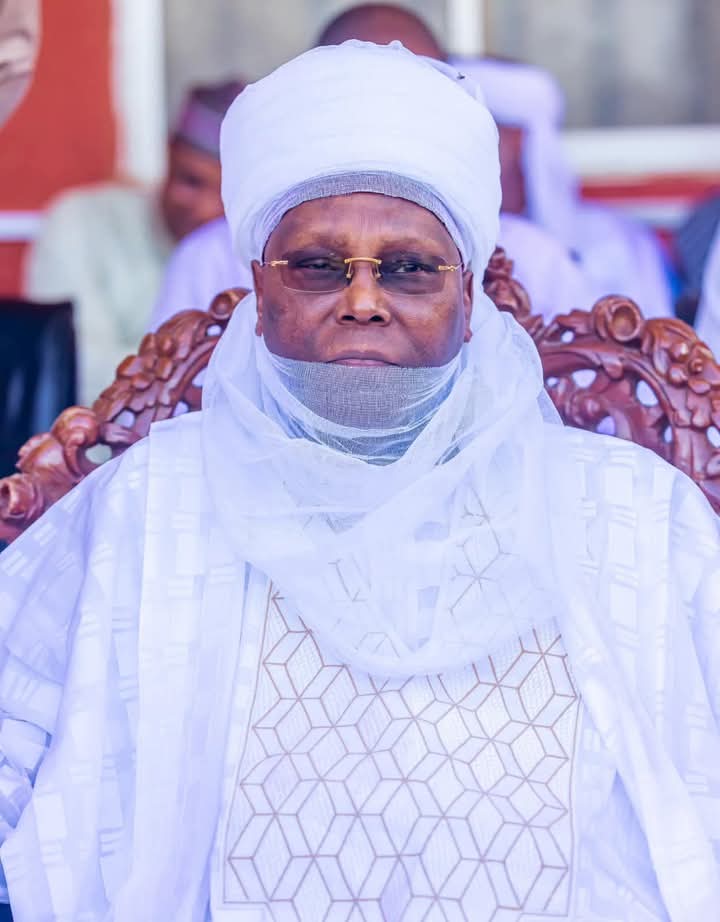
The Adamawa State Government has revoked the traditional title of Waziri Adamawa previously held by Nigeria’s former Vice President, Atiku Abubakar, citing revised indigeneship requirements for members of traditional councils across the state.

The decision was communicated in an official circular dated June 20, 2025, signed by Mrs. Adama Felicity Mamman, Permanent Secretary of the Department of Chieftaincy Affairs, Ministry for Local Government and Chieftaincy Affairs. The announcement marks a significant shift in traditional leadership protocol and has sparked widespread reactions given Atiku’s prominent political stature and the high esteem associated with the Waziri title.
According to the circular, the move followed the recent creation of new chiefdoms by Governor Ahmadu Umaru Fintiri. The government now mandates that all kingmakers and traditional council members must be indigenes of their respective chiefdoms to qualify for traditional appointments.
“Following the creation of new Chiefdoms in the state by the Executive Governor of Adamawa State, Rt. Hon. Ahmadu Umaru Fintiri, I am directed to inform you that all Kingmakers and Council members in the state must be indigene of their Chiefdoms,” the circular stated.
It further elaborated on the geographical restrictions, specifying that for the Adamawa Emirate Council, eligible persons must hail from Yola South, Yola North, Girei, Mayo-Belwa, Song, and Zumo Districts. Similarly, those from the Mubi Emirate Council must be from Mubi North or Mubi South, in accordance with the same policy framework.
The directive, which also affects the holder of the Walin Adamawa title, is widely seen as having political undertones, especially as Atiku remains one of the most influential opposition figures in Nigeria. The Waziri Adamawa title is second only to the Lamido of Adamawa in the emirate’s traditional hierarchy and is historically reserved for a person of exceptional standing and service to the emirate.
While the government has framed the decision as part of a broader administrative realignment to ensure local representation and cultural alignment, political observers interpret the move as a calculated attempt to weaken Atiku Abubakar’s influence in his home state, particularly as political realignments intensify ahead of the 2027 general elections.
As of press time, neither Atiku Abubakar nor the Adamawa Emirate Council has officially responded to the development.
